
How to solve puzzles in escape games comes down to three habits you can repeat under pressure: search systematically, communicate clearly, and test ideas without getting stuck on one “clever” theory.
Most groups don’t fail because they’re “bad at puzzles.” They fail because they waste time, split attention the wrong way, or miss information that was literally in the room. Escape games reward steady process more than raw IQ.

This guide gives you a repeatable playbook: how to search without chaos, how to sort puzzle types, how to avoid common trap behaviors, and what to do when you hit a wall. You’ll also get a quick table you can keep in mind on game day.
Build a repeatable “room workflow” (the part most teams skip)
When people ask how to solve puzzles in escape games, they usually want a clever trick. In practice, your workflow creates most of your advantage, because it prevents missed clues and duplicated work.
Start with a fast, organized sweep
- One person calls zones: left wall, back wall, furniture, shelves, floor-level, etc.
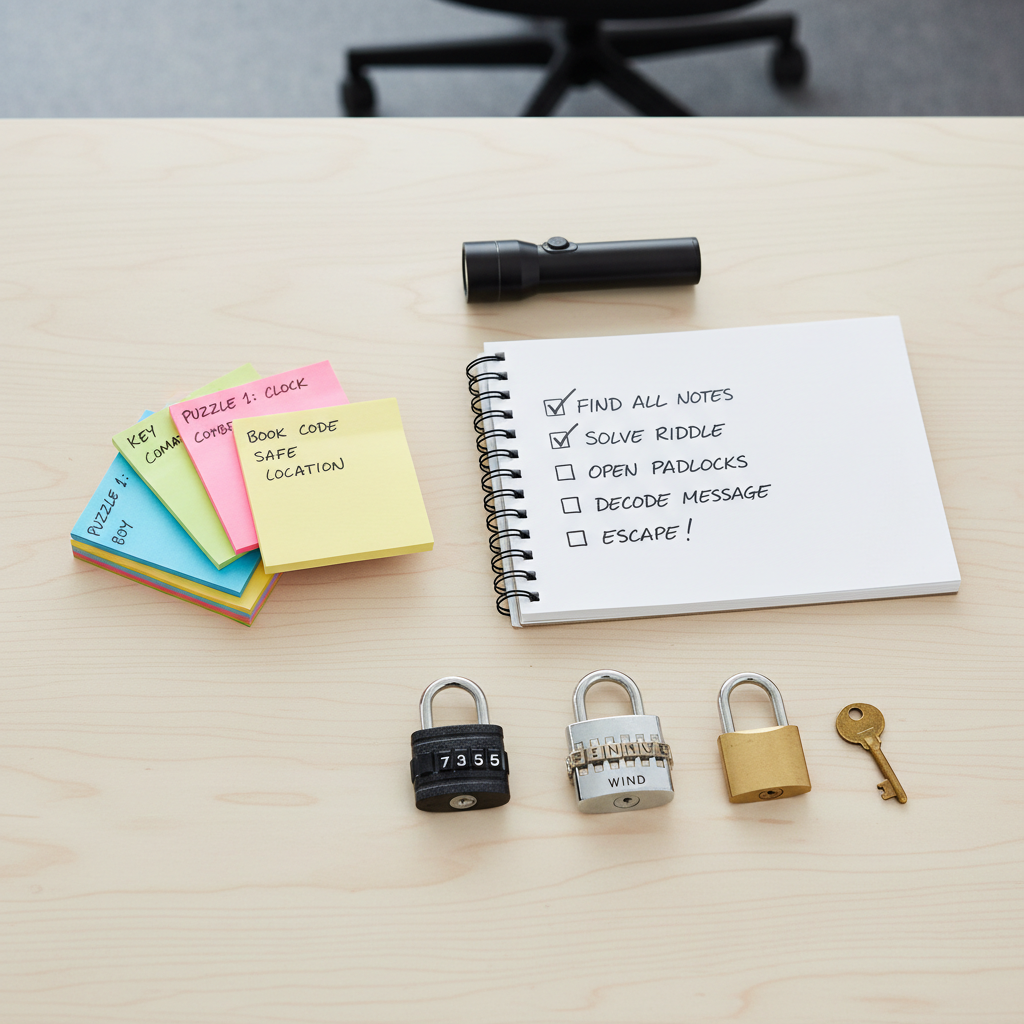
- One person becomes the recorder: writes down found items, codes tried, and anything “almost solved.”
- Everyone else searches and places items in a single “clue staging area” (table or clear surface).
This “staging area” sounds basic, but it keeps your team from losing tiny keys, mixing props, or forgetting where a clue came from.
Label what you find immediately
- Say it out loud: “Found a 4-digit lock on the red box.”
- Describe details, not guesses: “Paper says ‘Orion’ with three stars circled,” not “This must be astronomy.”
- Park odd items together: keys, magnets, UV pens, puzzle wheels.
Recognize common escape-game puzzle types (so you stop guessing blindly)
A big time drain is trying random inputs. You move faster when you identify puzzle families and then apply the right method.
| Puzzle type | What it often looks like | What to do first | Common mistake |
|---|---|---|---|
| Combination locks | 3–5 digits, directional locks, letter locks | Count digits/letters, search for matching format | Trying “fun” numbers with no evidence |
| Pattern/sequence | Dots, arrows, colors, shapes | Look for order cues: numbers, rows, clock faces | Ignoring orientation (left/right/up/down) |
| Word/cipher | Substitution, book cipher, anagram, riddles | Check for a key/legend somewhere in the room | Assuming it’s “too hard” before locating the key |
| Physical/mechanical | Sliding panels, magnets, hidden latches | Inspect seams and “interactive” surfaces gently | Forcing props (breaks immersion and rules) |
| Audio/visual | Sound clips, lights, monitors | Record the sequence and replay mentally as needed | Relying on memory instead of writing it down |
Escape rooms are designed to be solvable, but often only after you find the “key” information that makes the puzzle fair. If you don’t have that key, brute-force guessing usually burns time.
Use communication rules that prevent “team chaos”
Two teams can find the same clues; the one that wins is the one that keeps shared context. That’s the unglamorous secret behind how to solve puzzles in escape games consistently.
Adopt a “say it once, write it once” habit
- Announce finds so the whole group updates their mental map.
- Write critical data: any sequence, any symbol set, any partial decode, any lock type.
- Declare ownership: “I’m working the 5-letter lock,” so two people don’t duplicate.
When someone has a theory, ask for the evidence
Not in a confrontational way, just practical: “What clue points to that?” If the answer is vibes, pause the theory and go back to collecting inputs. Many rooms are built to tempt you into overthinking.
A quick self-check when you’re stuck (90-second reset)
Getting stuck happens in almost every game. The difference is whether you spiral or reset. Use this short checklist when momentum drops.
- Do we know what we’re solving? Identify the output: 4 digits, 3 arrows, a word, a key location.
- Do we have all the inputs? If a puzzle references 6 symbols, make sure you’ve found all 6.
- Did we misread the format? Example: letters vs numbers, clockwise vs counterclockwise, capitalization.
- Are we mixing puzzles? Separate clue piles; many rooms run multiple puzzle tracks.
- Is this a “later” puzzle? Some locks are meant to stay locked until you open another container.
- Have we searched again with fresh eyes? Quick resweep of obvious places, especially near solved areas.
If your team does this reset out loud, you’ll often spot the missing piece immediately, or at least stop wasting time on the wrong path.
Practical solving tactics that work across most rooms
These are the methods that reliably convert clues into answers, without assuming a specific theme or franchise.
Match clue format to lock format
- If you see four blank squares, look for a 4-digit lock.
- If a note emphasizes colors, look for a color keypad, LEDs, wires, or colored symbols.
- If you find directional arrows, check for a directional lock or a grid movement puzzle.
Use “constraints” to narrow solutions
Constraints are boundaries the room gives you: “enter 5 letters,” “use the painting order,” “only one item fits.” Treat them as guardrails. If a solution violates constraints, it’s probably wrong even if it feels clever.
Split by strengths, then rotate
- One person: detail search (finding hidden compartments, noting odd textures, checking corners).
- One person: logic/sequence work (ordering items, mapping symbols).
- One person: physical interactions (aligning objects, trying keys, handling mechanisms gently).
After 8–10 minutes, rotate if progress stalls. Fresh attention beats grinding.
Take hints strategically, not emotionally
Many venues expect you to use hints; it’s part of the design. According to Escapology (a major escape room operator), hint systems are common to keep teams moving and enjoying the experience. If you spend more than a few minutes with no new information, a hint can be a good trade.
Common mistakes that quietly kill your time
Most of these look harmless in the moment, then you realize you burned 15 minutes and morale dips. Catch them early.
- Hoarding clues: someone pockets items “to work on later,” and the team loses visibility.
- Overthinking props: not every book title or wall texture is a cipher key.
- Random testing: entering codes without a reason makes you forget what you tried and why.
- Not tracking partial work: you solved half a cipher, walked away, then re-solved it.
- Forcing objects: many rooms use delicate triggers; force creates damage and delays.
A small rule helps: if you can’t explain why you’re trying something in one sentence, pause and find the missing clue instead.
When to ask for help (and how to make the hint actually useful)
Some players treat hints like “failure,” then they lose the game on pride. Others mash the hint button constantly and never learn the room’s logic. There’s a middle path.
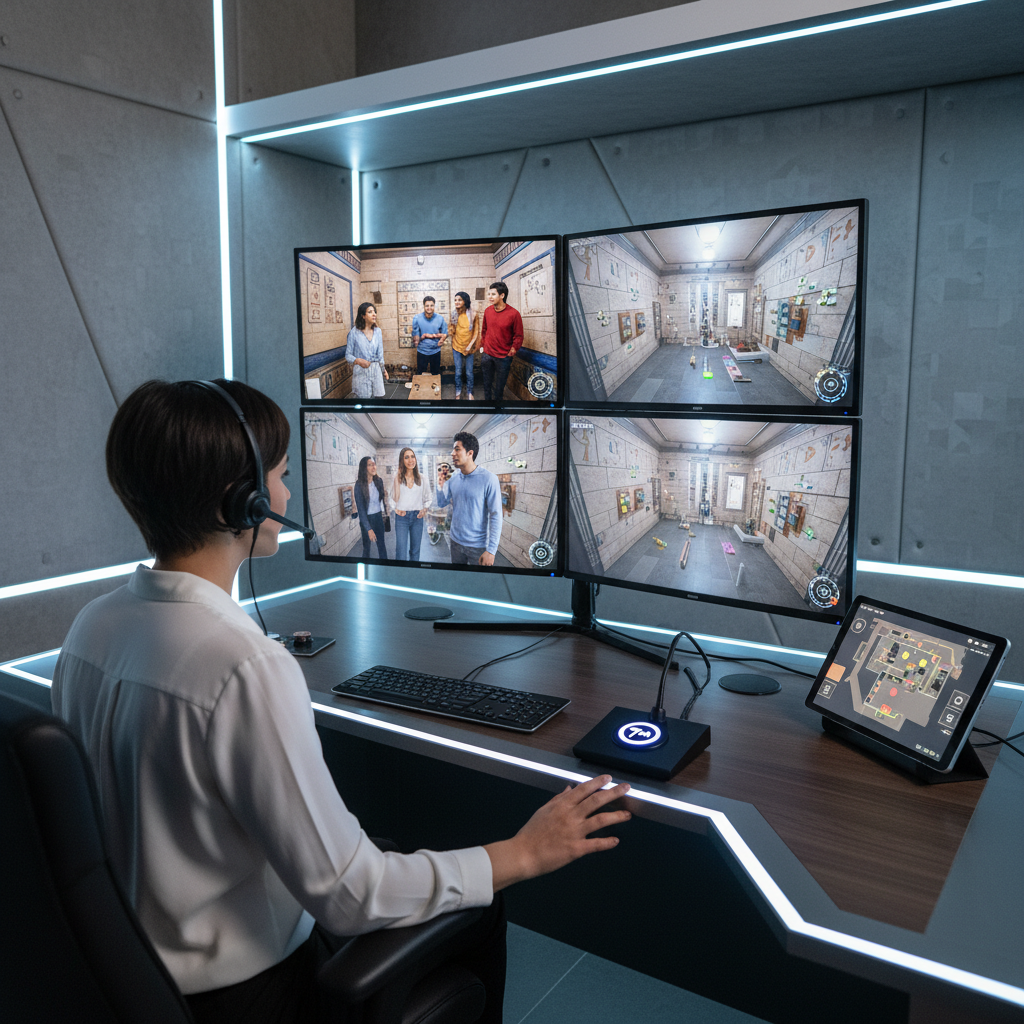
- Ask when your team can’t define the next actionable step after a reset.
- Ask when you suspect a mechanical interaction exists but you can’t find the safe trigger point.
- Ask when you solved something but the room didn’t respond, which may suggest a misread input format.
When you request a hint, give context: “We have the 4-digit lock, we found three numbers and a star chart, we don’t see the fourth digit.” That usually gets you a nudge instead of a spoiler.
If the room involves tight spaces, flashing lights, or physical crawling, consider your comfort level and let staff know if you need accommodations. For any health or safety concern, it’s reasonable to step out and consult venue staff.
Key takeaways you can use in your next game
How to solve puzzles in escape games becomes much easier when you stop chasing “genius moments” and start running a clean process. Search in zones, stage clues in one place, write down anything that changes over time, and reset quickly when you stall.
Your next step is simple: before your next session, agree on roles for the first five minutes and decide how you’ll record clues. That one decision alone tends to prevent the most common time-wasters.
FAQ
How do you solve escape room puzzles faster without missing clues?
Use a zone-based sweep and a single staging area for items, then announce finds out loud. Speed comes from avoiding re-searching and duplicated effort, not from rushing.
What should you do if two puzzles seem to use the same symbols?
Assume they might be separate tracks until you find a clear “bridge clue” that connects them, like a legend, a matching lock format, or an instruction card. Mixing tracks is a classic time sink.
Is it OK to take hints in an escape game?
Usually, yes. Many rooms are designed with hint systems so teams keep moving. If you’re stuck and can’t define the next step, a small nudge can save the experience.
How can you tell if a locked box is meant for later?
If you don’t have enough inputs to produce the right format (for example, you need 5 letters but only found 2), park it and continue searching. “Later” locks often become obvious once another container opens.
What’s the best way to track codes you already tried?
Write them down with where you tried them and the result. Even a simple list like “Blue box: 4281 no” prevents circular guessing when stress rises.
Why do teams overthink escape rooms so often?
Because themes create false depth, and people assume everything is a puzzle. A good reality check is to ask: “What does the room want as an output?” If you can’t answer that, you’re probably not on a real puzzle yet.
How do you handle a teammate who dominates the solving?
Give them a specific lane (like ciphers) and keep a shared recorder. Dominance becomes less of an issue when the team has visible notes and clear ownership of tasks.
If you’re planning a team outing and want a more predictable win rate, it helps to pick a room with a clear hint system and difficulty that matches your group, then go in with a simple search-and-record routine instead of improvising everything under the clock.